Vince Massimo has written a fascinating article about the Humming-bird Hawk-moth, leading us through the breeding cycle, from egg to adult life, and with delightful images to match. What is shown below is a slightly modified, shortened version of the full article which is on the UK Butterflies national website. Please click on the link to enjoy the full version at https://ukbutterflies.co.uk/phpBB/viewtopic.php?p=193709
This distinctive day-flying moth is primarily a migrant to our shores, but the adult can over-winter resulting in sightings in March and April. In 2025 the Sussex BC website reported adult sightings of this moth on March 4, 6, 8(x2), 10, 23, and 25, all near the south coast, with a small influx on May 30-31 seen along the coast and then further inland the following day. On 1 June in Hove, Jason Read found a mature 5th instar larva on Hedge Bedstraw. According to data compiled by Martin Kalaher (Sussex BC), the average first-sighting date for the years 2007-2015 in Sussex is 28th March, but this falls to 8th March for the years 2016-2024.
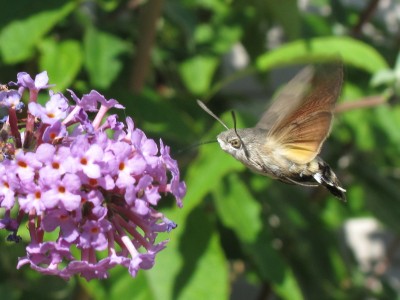
Humming-bird Hawkmoth - Lancing, Sussex 27-Aug-2022
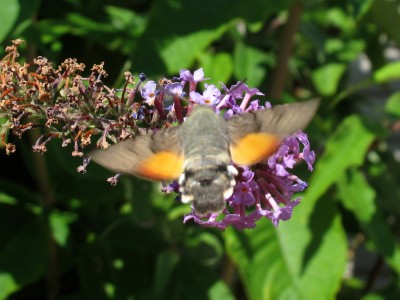
Humming-bird Hawkmoth - Lancing, Sussex 27-Aug-2022
According to the "Field Guide to the Moths of Great Britain and Ireland" by Waring, Townsend, and Lewington (2004 edition), larval foodplants include Lady's Bedstraw, Hedge Bedstraw, and Wild Madder, with eggs also being observed on Red Valerian. I have also seen egg-laying on Red Valerian on the south coast of Sussex. On the first occasion the first instar larva died after two days and on the second instance the eggs were either unviable or were parasitised. Another host plant is Cleavers ( Galium aparine ) upon which I found an egg on 3rd April 2025 in Crawley, Sussex, being the subject of this report. This is a very early time to find an egg, suggesting that it either came from an early migrant or an overwintering adult. Given that the spring of 2025 was the warmest in the UK since 1884 as well as one of the sunniest and driest, I cannot rule out either possibility, but it was between 12 and 24 miles north or north-west of the March sightings.
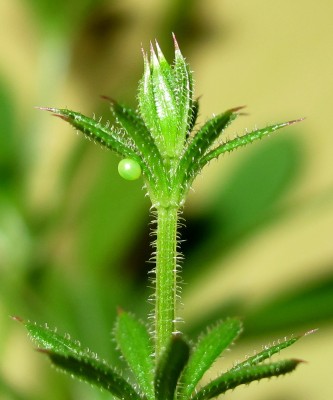
The egg is laid singly on the foodplant, in this case Cleavers. It is pale green at first, spherical in shape, approximately 1mm in diameter and developing a shallow disc-shaped depression in the top as the larva formed. Details of hairs and other structures of the larva became increasingly clear inside the shell as it neared emergence. The estimated time taken for the larva to hatch is 7–14 days. This is based on observing only two viable eggs.
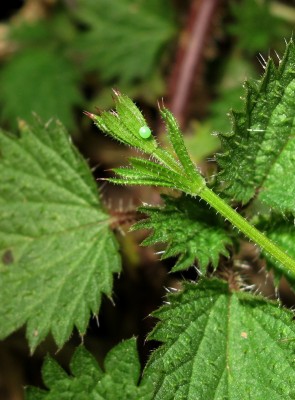
Egg on Cleavers - Crawley, Sussex 3-April-2025
Egg on Cleavers - Crawley, Sussex 5-April-2025
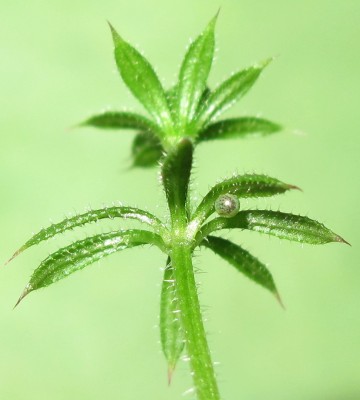
Developing egg - Crawley, Sussex 10-April-2025
I recorded five instars, with the larva eating its old, shed skin after each moult. The eggshell was not present after hatching, indicating it may have been consumed (based on two observations).
1st instar
The larva is approximately 2mm in length when it emerges, with a grey head and a black tail-spike. The body is very pale yellow to start with but takes on a pale green tint after feeding, becoming overall pale green just before moulting. When not feeding, it typically rests head down. After five days and when fully grown in this instar the larva is approximately 4.5mm in length.
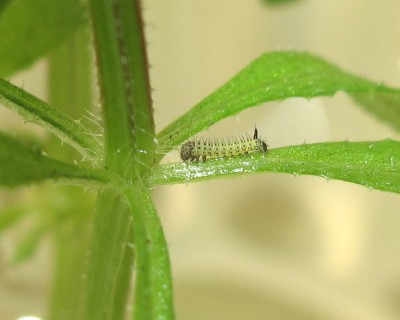
Newly emerged 1st instar larva 11-April-2025 (Day 1)
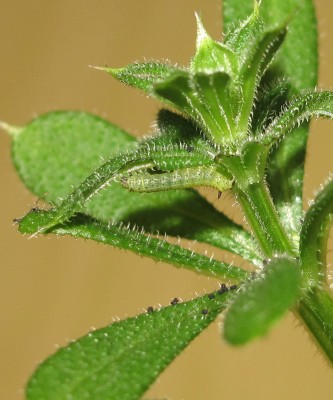
1st instar larva 14-April-2025 (Day 4)
All moults occur in a head-down position. Approximately one hour after each moult, the larva turns round and eats its old, shed skin.
2nd instar
The larva is green with a green head and two faint stripes along each flank, the bottom one being much paler. After 3 days and when fully grown in this instar the larva is 8.5mm long.
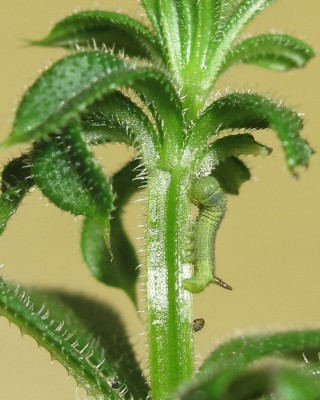
2nd instar larva eating old skin 16-April-2025 (Day 6)
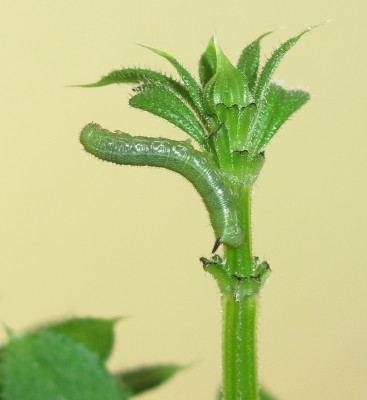
2nd instar larva 18-April-2025 (Day 8)
3rd instar
The larva has slightly more accentuated detailed colouration than its predecessor. After 3 and a half days and when fully grown in this instar the larva is 13mm long.
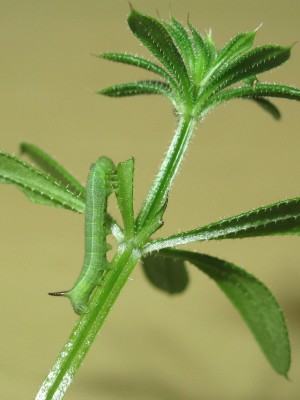
3rd instar larva 20-April-2025 (Day 10)
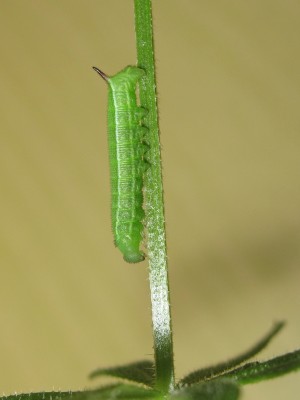
3rd instar larva (pre-moult) 22-April-2025 (Day 12)
4th instar
The larva has more prominent stripes, the upper one being whiter, while the lower one is yellower and the spiracles are more prominent. The green colouration of the body now appears more solid. After almost 5 days and when fully grown in this instar the larva is 25mm long.
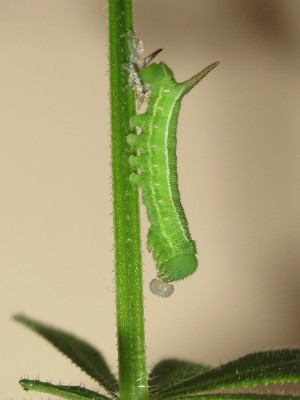
Newly moulted 4th instar larva 23-April-2025 (Day 13)
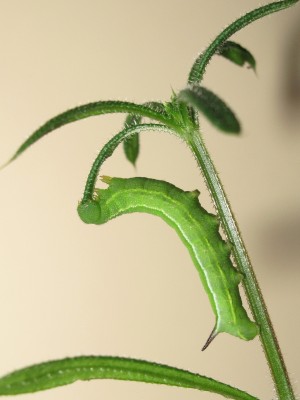
4th instar larva 25-April-2025 (Day 15)
5th instar
The larva has a smooth green skin with both stripes appearing more prominent than before. The spiracles are also larger and have a brown centre. The eight sucker pads are now red, as are the six true legs and the tail has become bluer with a yellow tip. It doubles in length in four days and when fully grown in this instar the larva is 51mm long.
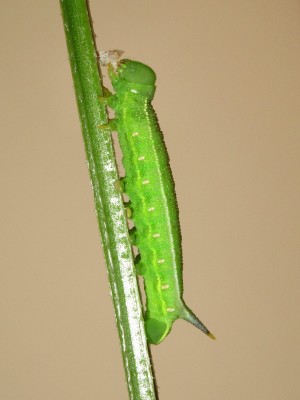
5th instar larva eating old skin 27-April-2025 (Day 17)
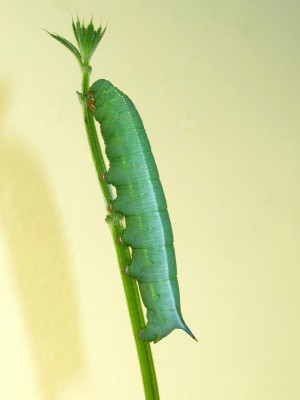
5th instar larva 1-May-2025 (Day 21)
Other 5th instar
Jason Read and Allan Ward kindly provided images of other 5th instar larvae.
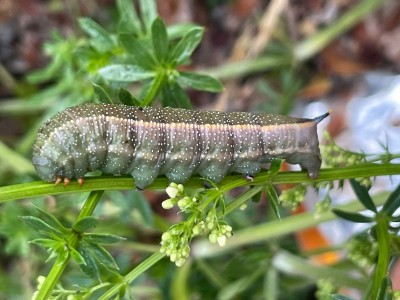
5th instar larva (brown form) - Hove, Sussex 1-June-2025 (Jason Read)
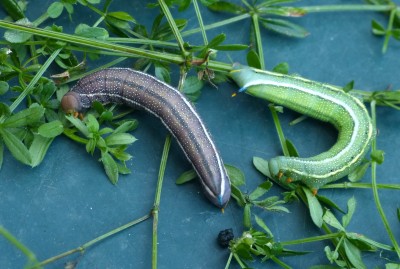
5th instar larvae - Kent 15-Aug-2025 (Allan Ward)
After it stops feeding and leaves the foodplant, it becomes restless (at which point it is moved to a container with a mixture of light soil and potting compost). The larva initially turns dark green, then gradually to purple as it prepares to pupate. Approximately 8 hours after it stops feeding it starts to spin a loose, domed-shaped cocoon of silk strands, onto the outside of which it incorporates soil and debris. Here it rests for a further four days before pupating.
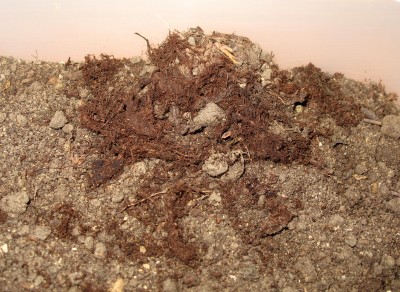
Cocoon exterior 3-May-2025 (Day 23)
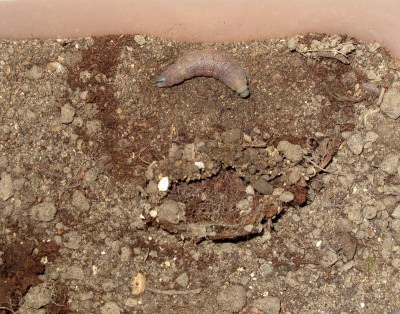
Pre-pupation larva 3-May-2025 (Day 23)
*The cocoon was only opened after the larva had become completely inactive and there was no danger of it moving or being disturbed.
The 35mm-long pupa is quite pale with mottled markings on its wing cases. It remained like this for 23 days, then gradually started to darken at which point some internal details started to become discernible. Darkening continued for two more days, then after lightening slightly in the next 12 hours the adult moth emerged. This procedure was abrupt and took about 12-15 seconds. The empty pupal case remained dark grey in colour.
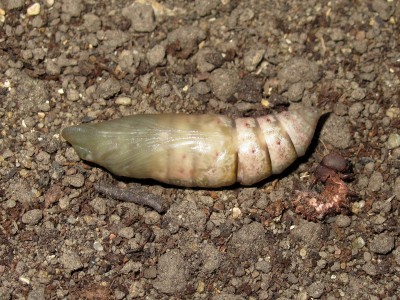
Fresh pupa (ventral view) 6-May-2025 (Day 26)
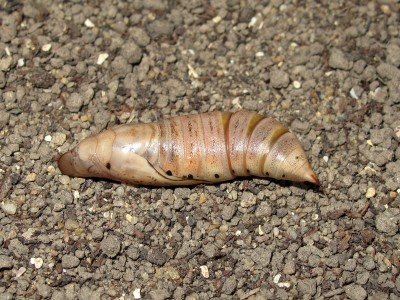
Pupa (dorsal view) 27-May-2025 (Day 47)
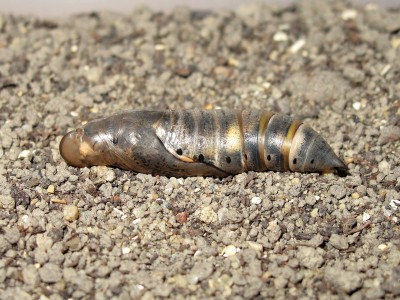
1 hour prior to emergence (dorsal view) 1-June-2025 (Day 52)
The newly emerged adult expelled a grey/green meconium and climbed up a stick to expand and dry its wings. At first, the wings were held flat while they are expanded and then erect for a time before being positioned flat against the body again to harden. Two hours after emerging, the moth was ready to fly and released into the garden. The date of the release coincided with reports of a small influx of new adults from Worthing and Brighton on the south coast.
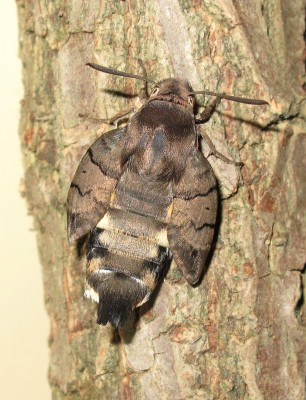
Adult expanding wings 1-June-2025 (Day 52)
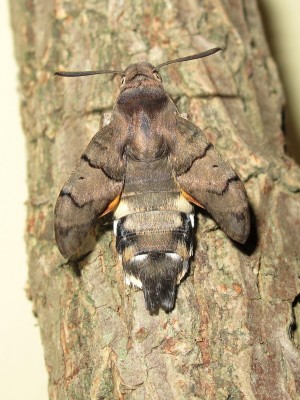
Adult expanding wings 1-June-2025 (Day 52)
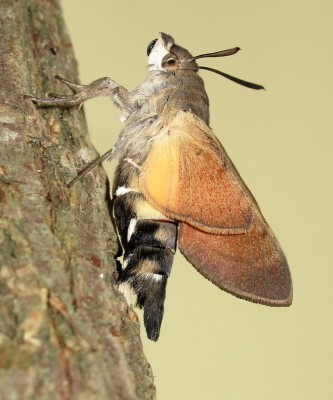
Adult hardening wings 1-June-2025 (Day 52)
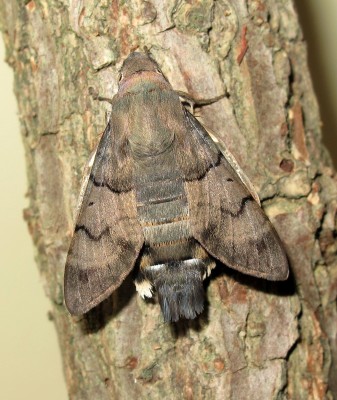
Fresh adult prior to release 1-June-2025 (Day 52)
The sunny bank of a small stream (Broadfield Brook) alongside a public footpath. (TQ25882 35330). Only small amounts of the larval host plant, Cleavers, was found growing amongst nettles and other plants. The egg was found by chance and initially considered to be a stray Speckled Wood egg.
The dates and timings relating to the development of this larva are just for guidance and may not be typical of the species because (a) it was reared, (b) was the product of a very early egg and (c) it developed during the warmest spring in the UK since records began.
3 April 2025 – Egg discovered; likely laid between 28 March and 2 April (estimated from hatching date).
11th April 2025 - Egg hatched early in the morning. 1st instar for 5 days and 3 hours. Larval length 2mm-4.5mm.
16th April 2025 - Moulted to 2nd instar. In this instar for 3 days and 1 hour. Larval length 4.5mm-8.5mm.
19th April 2025 - Moulted to 3rd instar. In this instar for 3 days and 15 hours. Larval length 8.5mm-13mm.
23rd April 2025 - Moulted to 4th instar. In this instar for 4 days and 20 hours. Larval length 13mm-25mm.
27th April 2025 - Moulted to 5th instar. In this instar for 8 days and 7 hours but fully grown and stopped feeding after 3 days and 22 hours. Larval length 25mm-51mm.
6th May 2025 – Pupated at approximately 06.30. Pupal length 35mm.
1st June 2025 – Adult emerged after 26 days and 3 hours. Body length 30mm and wingspan 26mm at rest.
The larva reared was the green form, the other is the brown form, there also being slight colour variations within each form.
Martin Kalaher – Editor of Butterfly Conservation Sussex Branch website and keeper and compiler of historical Sussex sightings data.
"Field Guide to the Moths of Great Britain and Ireland" Waring/Townsend/Lewington (2004 edition) for larval foodplant information and status.
Met Office weather data.
Jason Read for use of his image of a brown form of the larva.
Allan Ward for use of his image of both colour forms of the larva.